CSAE AT 40: DIRECTOR'S INTRODUCTION
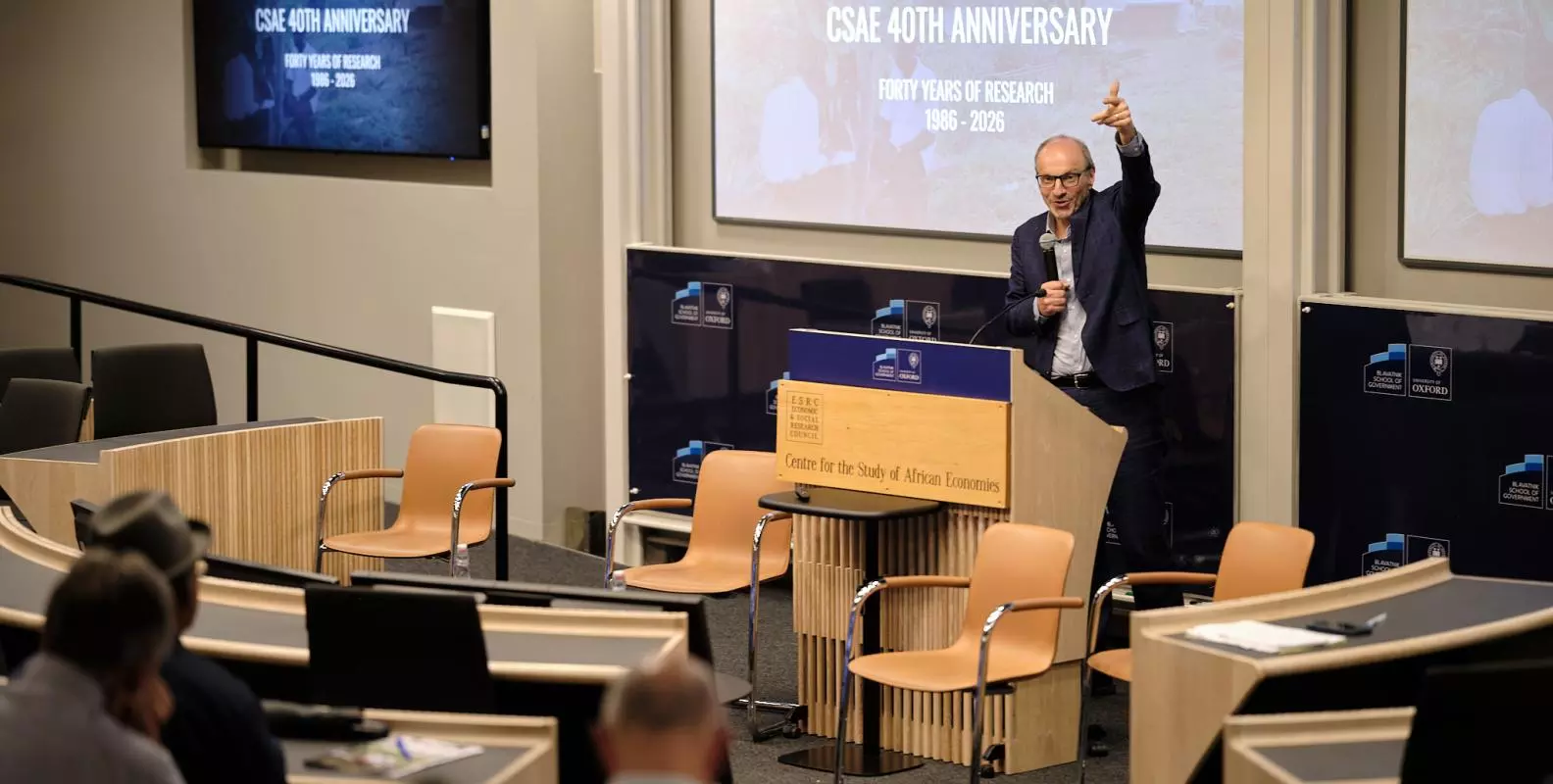
By Stefan Dercon, current CSAE Director, Professor of Economic Policy, University of Oxford
I joined the Centre in 1992 as a postdoctoral researcher, and it has been a privilege to witness its growth and development over more than three decades, culminating in my appointment as Director in 2015. Looking back over the history of the Centre for the Study of African Economies, what stands out most clearly is the strength of the original vision: that the study of African economies deserved the same intellectual seriousness, analytical rigour, and empirical attention as any other economy in the world.
Today, that proposition may seem self-evident. In the mid1980s, it was not. At the time, much work on Africa was framed through assumptions of exceptionalism, that African economies were somehow too different to be analysed using the tools of mainstream economics. The founders of CSAE, Paul Collier, David Bevan, and Jan Willem Gunning, took a different view. They believed African economies should be studied carefully, comparatively, and rigorously, drawing on the same standards of evidence and analytical methods applied elsewhere. That commitment was ambitious, and in some quarters controversial, but it laid the foundations for everything that followed.
The origins of the Centre date back to July 1986, when a small group in Oxford established a unit dedicated to development economics in Africa. A few years later, in 1989, the group applied for designation as an ESRC Research Centre, at the time one of only two such centres in economics across the UK. Out of 157 applications, CSAE was awarded the grant. It was a remarkable achievement, particularly at a moment when development economics attracted very limited institutional funding. The award transformed the original unit into the Centre for the Study of African Economies and gave it the platform to build something enduring.
In those early years, CSAE established itself as a leading place for rigorous empirical research on Africa. The Centre pioneered largescale longitudinal data collection on firms and households across the continent, work that had rarely been attempted at such scale before. At the same time, researchers at CSAE advanced modern macroeconomic analysis of African economies, an area largely confined to international financial institutions rather than universities.
Throughout the 1990s, the Centre helped place African economic research firmly within the mainstream of the discipline. The Centre’s influence extended well beyond academia. Through long-standing collaborations, particularly with the African Economic Research Consortium (AERC), CSAE contributed significantly to strengthening economic policymaking capacity across the continent. One of the most important impacts was in central banking, where generations of economists and policymakers received advanced training and developed more rigorous approaches to monetary and economic management. Many individuals associated with CSAE went on to become central bank governors, ministers, senior advisers, and leading academics across Africa.
Paul Collier and Jan Willem Gunning in Nairobi.
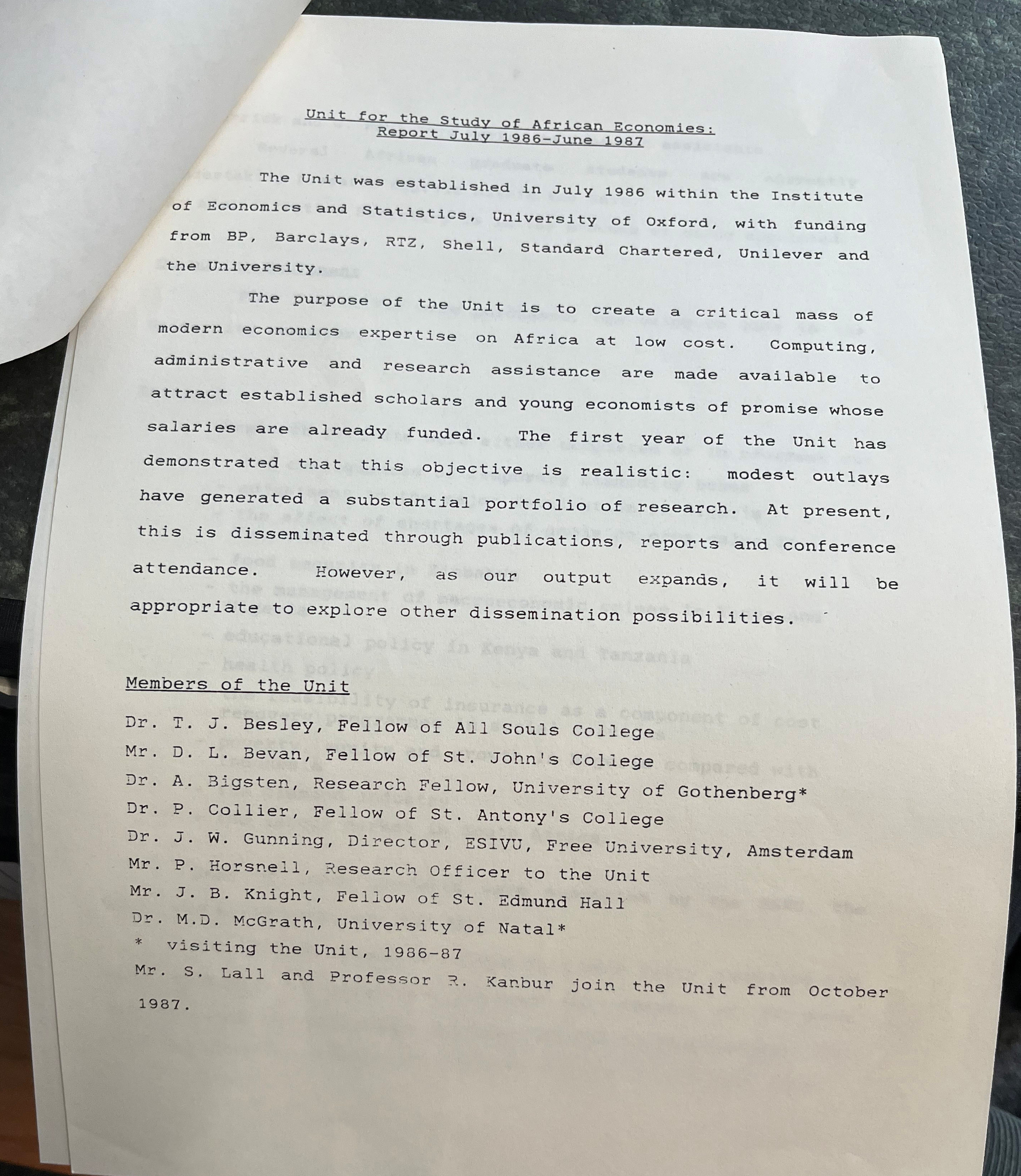
Quote from the Unit for the Study of African Economies Report, July 1986 - June 1987The purpose of the Unit is to create a critical mass of modern economics expertise on Africa at low cost. Computing, administrative and research assistance are made available to attract established scholars and young economists of promise.
The Centre also invested deeply in higher education partnerships. A particularly important initiative was the establishment of a master’s programme in economic policy at Addis Ababa University. Initially taught with substantial CSAE involvement, the programme was later fully transferred to local faculty and continues successfully today. Many of its graduates now occupy senior positions in Ethiopian public life and economic policymaking
By the 2000s, CSAE had become the largest concentration of economists working on Africa within a university setting anywhere in Europe, while maintaining exceptionally close ties with institutions and researchers across the continent. The Centre’s work expanded into new areas, including firms and productivity, conflict, intra-household dynamics, and social networks, while remaining grounded in careful empirical research and policy relevance.
The Centre itself also evolved institutionally. Originally rooted entirely within Oxford’s Department of Economics, CSAE increasingly became a broader intellectual network linking researchers across the University. The growth of the Oxford Department of International Development (then Queen Elizabeth House) and the founding of the Blavatnik School of Government further strengthened these connections, creating a wider interdisciplinary community working on development and Africa while remaining closely associated with CSAE.

The first cohort of students on the Master’s programme in Economic Policy Analysis in Addis Ababa.
One of the clearest expressions of the Centre’s role as a convening institution is the CSAE Conference. First held in 1997 on a relatively modest scale, it has grown into the largest annual conference in development economics focused on Africa, attracting scholars from across the world. What matters most, however, is not simply its size, but the intellectual and institutional connections it creates. The conference has become an important platform for emerging African scholars, many of whom receive support to attend and present their work in Oxford. In recent years, we have strengthened this further through pre-conference workshops held on the continent, bringing together researchers from African institutions and Oxford several months before the main conference to develop papers and provide detailed feedback.
Over the past four decades, development economics itself has changed enormously. What was once a relatively marginal field is now at the forefront of methodological and policy innovation in economics. Throughout these changes, CSAE has remained true to its founding purpose: combining rigorous research with deep engagement in the real economic challenges facing African countries.
What began in 1986 as a small research unit has become a global intellectual community. Today, CSAE researchers hold appointments across departments and disciplines throughout Oxford, while we continue to attract outstanding scholars committed to research on Africa and development. The Centre’s greatest achievement is not simply the body of work it has produced, but the generations of students, researchers, and policymakers who have passed through it and continue to shape economic thinking and policy across the continent and beyond.
As we mark the 40th anniversary of CSAE, we celebrate not only an institution, but a continuing commitment to rigorous scholarship, meaningful partnership, and the belief that careful research can contribute to better policy and better lives.