

For more than three decades, the relationship between the Centre for the Study of African Economies (CSAE) and Addis Ababa University (AAU) has helped shape graduate economics training and empirical research in Ethiopia. Emerging at a pivotal moment in the country’s history, the partnership supported the rebuilding of academic capacity after years of isolation and laid the foundations for a generation of influential economic scholarship and policy engagement.
The relationship began in the early 1990s, when Ethiopia was emerging from the Derg regime, a period during which the country’s universities had been largely cut off from mainstream international academic networks. Access to journals, research collaboration, and postgraduate training opportunities had been severely constrained. At the same time, there was a strong determination within Ethiopia’s academic community to reconnect with global scholarship while building institutions on Ethiopian terms.
Professor Taye Mengistae, then Chair of the Department of Economics at AAU, recalls that the first connection between AAU and CSAE emerged through the African Economic Research Consortium (AERC). In 1991, AERC’s leadership introduced him to Professor Paul Collier, the founding director of CSAE. “In taking the initiative,” Mengistae writes, “Paul visited the Department of Economics at the AAU that year to meet with staff of our department and the dean of our faculty and relevant higher officials of the AAU.”
Professor Taye Mengistae Addis Ababa University Former Chair of the Economics DepartmentThe enrollment of staff of Economics at the AAU to graduate studies in Economics at Oxford was intended to eventually lead to a state where the Department of Economics at the AAU will be self-sufficient in running its own graduate programmes without the need to draw on the external support of the kind the CSAE provided it with in the second of half the 1990s and thereafter. The collaboration between the CSAE and Economics at the AAU would then evolve to the kind that you have between the departments of the same discipline in Europe or North America or any other part of the globe.
That initial contact quickly developed into a much broader institutional collaboration. The AAU economics department had secured support from the European Commission to establish a major capacity-building programme and sought an international academic partner. Rather than accepting a recommended institution, AAU leaders visited universities and research centres across Europe before selecting CSAE and Oxford as their preferred collaborators. As Stefan Dercon later reflected, “They picked us — it’s not that we picked them.”
The partnership formally began in 1992 with the reorganisation and development of AAU’s Master’s in Economic Policy Analysis programme. CSAE faculty and researchers travelled to Addis Ababa to teach on the programme and help establish its curriculum during its formative years. Among those involved was Professor Stefan Dercon, now Director of CSAE, who spent two academic terms in Addis alongside Professor Pramila Krishnan and other CSAE researchers helping to launch the programme.
At the outset, the task was ambitious. The programme had to be built almost from scratch, with CSAE faculty initially teaching most of the courses while working closely with Ethiopian colleagues. From the beginning, the collaboration was designed to support AAU in developing its own long-term academic capacity.
Mengistae describes this clearly: “The enrollment of staff of Economics at the AAU to graduate studies in Economics at Oxford was intended to eventually lead to a state where the Department of Economics at the AAU will be self-sufficient in running its own graduate programs without the need to draw on the external support of the kind the CSAE provided.”
This emphasis on local ownership became one of the defining characteristics of the partnership. Over time, AAU increasingly took responsibility for teaching and managing the graduate programme itself. The collaboration evolved away from direct operational support toward a relationship based on scholarly exchange, joint research, and professional networks.

The first cohort of students on the Master’s programme in Economic Policy
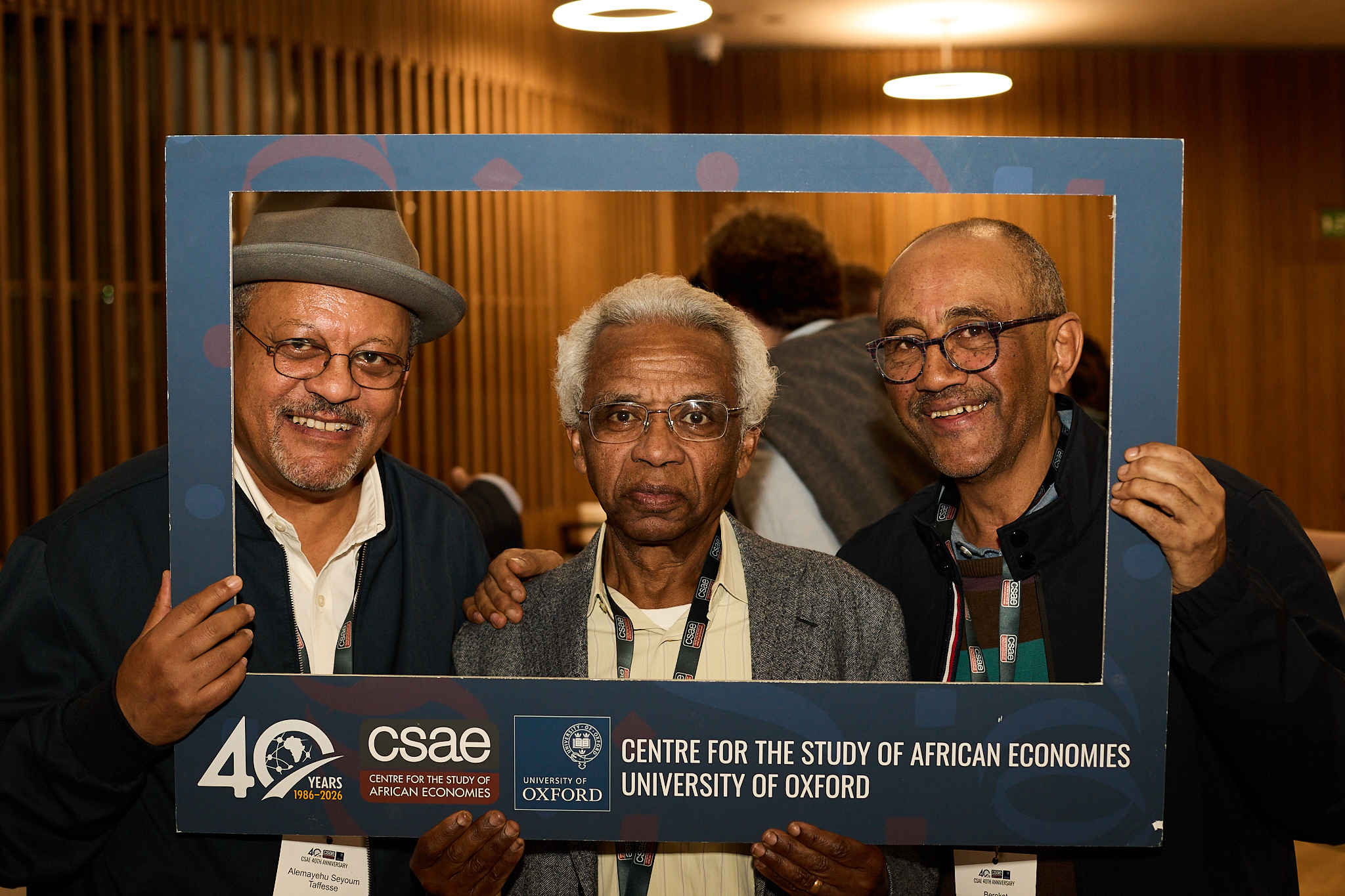
Alemayehu Seyoum Taffesse, Taye Mengistae and Bereket Kebede in the 40th anniversary frame, 2026
Professor Tassew Woldehanna Addis Ababa University and President of the Ethiopian Economic AssociationBeyond the University, CSAE’s research outputs have informed practitioners, policymakers, and development partners, strengthening evidence based decision making across the country. As a result, the research connections between CSAE, AAU, and the broader Ethiopian scholarly community have matured into a vibrant
ecosystem of shared knowledge, methodological exchange, and collaborative inquiry that continues to shape economic research and policy dialogue in Ethiopia.
The impact of the Master’s programme was substantial. What began as a reconstruction effort became one of the flagship graduate economics programmes in Ethiopia. Many graduates moved into influential positions across government, academia, international organisations, and policy institutions. Early cohorts included mid-career civil servants and economists who had lived through the years of academic isolation under the Derg and were eager to reconnect with international debates in development economics.
Alongside the teaching partnership, CSAE and AAU developed a major collaborative research agenda that would prove equally influential. In 1994, researchers launched the Ethiopian Rural Household Survey (ERHS), one of the earliest and most important longitudinal household datasets in sub-Saharan Africa. Conducted over multiple rounds through to 2007, the ERHS became a cornerstone of empirical research on poverty, rural livelihoods, agriculture, shocks, and household behaviour in Ethiopia.
The survey emerged from an early CSAE vision of combining capacity-building with collaborative empirical research. Economists at Oxford and AAU recognised that rigorous panel data would not only generate internationally important scholarship, but also create opportunities for Ethiopian researchers and students to undertake high-quality quantitative research themselves.
Professor Tassew Woldehanna describes the importance of the ERHS in lasting terms: “CSAE’s long-standing partnership with the Economics Department, most notably through the joint collection of the Ethiopian Rural Household Survey (ERHS), has provided an invaluable data source for generations of researchers. The ERHS remains one of the most widely used datasets for studying poverty, rural livelihoods, and household behaviour in Ethiopia.”
The survey also helped establish Ethiopia as a major centre for empirical development research. At a time when high-quality longitudinal data were still rare across Africa, the ERHS enabled scholars in Ethiopia and abroad to conduct sophisticated analysis grounded in detailed evidence. The dataset supported countless Master’s dissertations, doctoral theses, journal articles, and policy studies. According to those involved, well over one hundred researchers may ultimately have used the data in their academic work.

Addis Ababa University building.
The collaboration surrounding the ERHS also launched individual careers and strengthened professional networks that continue today. Ethiopian researchers who worked on the survey later became senior academics, policymakers, and international researchers. Some pursued doctoral studies at Oxford and other international universities before returning to Ethiopia or taking up prominent global positions.
The partnership’s influence spread beyond AAU itself. Over time, CSAE researchers built links with Ethiopian policy institutions, think tanks, and research organisations, including the Ethiopian Economic Association and later the Ethiopian Development Research Institute, now the Policy Studies Institute. These relationships broadened the scope of collaboration while maintaining strong personal and institutional ties with AAU.
A number of Ethiopian scholars with CSAE connections went on to hold major leadership roles in academia and public life. Tassew Woldehanna later became President of Addis Ababa University and a leading researcher associated with the Young Lives longitudinal study. Other former collaborators and students assumed senior government positions, including roles in economic management and policymaking.
Yet participants in the collaboration consistently emphasise that these achievements were rooted in Ethiopian leadership and ambition. CSAE contributed expertise, training, and long-term partnership, but Ethiopian academics shaped the direction and priorities of the relationship. This mutual respect was central to its durability.
The collaboration also reflected a broader intellectual transformation. By the late 1990s and 2000s, Ethiopia had developed a growing community of empirically oriented economists and social scientists producing internationally recognised research. Annual CSAE conferences increasingly featured Ethiopian scholars presenting rigorous evidence-based work across a wide range of development topics. What had once been a small post-conflict reconstruction effort had evolved into a vibrant and internationally connected research ecosystem.
Professor Bereket Kebede University of East Anglia AAU Fieldwork Manager (1993-1997)In addition to contributing to academic research, ERHS has also helped to establish a strong relationship between CSAE and AAU, strengthened economics postgraduate training at AAU, attracted more data collection such as a parallel urban household survey (mainly supported by Gothenburg University, Sweden) and enterprise survey, provided invaluable experience and skill in running large scale panel household surveys (for instance, I know some of ERHS fieldwork supervisors later set up their own data consultancy firms in Ethiopia) and significantly improved empirical analyses and boosted the reputation of the economics department at AAU.
As Woldehanna writes, “The research connections between CSAE, AAU, and the broader Ethiopian scholarly community have matured into a vibrant ecosystem of shared knowledge, methodological exchange, and collaborative inquiry that continues to shape economic research and policy dialogue in Ethiopia.”
Forty years after CSAE’s founding, the relationship with Addis Ababa University stands as one of the Centre’s most enduring and influential partnerships. Grounded in trust, shared intellectual purpose, and a strong commitment to Ethiopian ownership, the collaboration helped strengthen graduate training, establish internationally recognised research, and support generations of scholars and policymakers.
The legacy of the partnership is visible not only in academic publications or datasets, but in the people and institutions it helped shape: graduate programmes that continue today, researchers trained through collaborative projects, policy institutions strengthened by evidence-based analysis, and scholarly networks that still connect Oxford and Addis Ababa more than three decades after the partnership began.
That enduring connection continues to find new forms. In December 2019, CSAE held the first CSAE Economic Development in Africa Workshop at Addis Ababa University, bringing together funded African participants ahead of the annual CSAE Conference in Oxford. Designed to support early-career researchers through feedback, discussion, and professional networking, the workshop reflected CSAE and AAU’s shared commitment to nurturing the next generation of African scholars. The workshop returned to Addis Ababa University again in 2025, reaffirming the lasting strength of a partnership that continues to evolve while remaining rooted in the collaborative spirit that first brought CSAE and AAU together in the early 1990s.
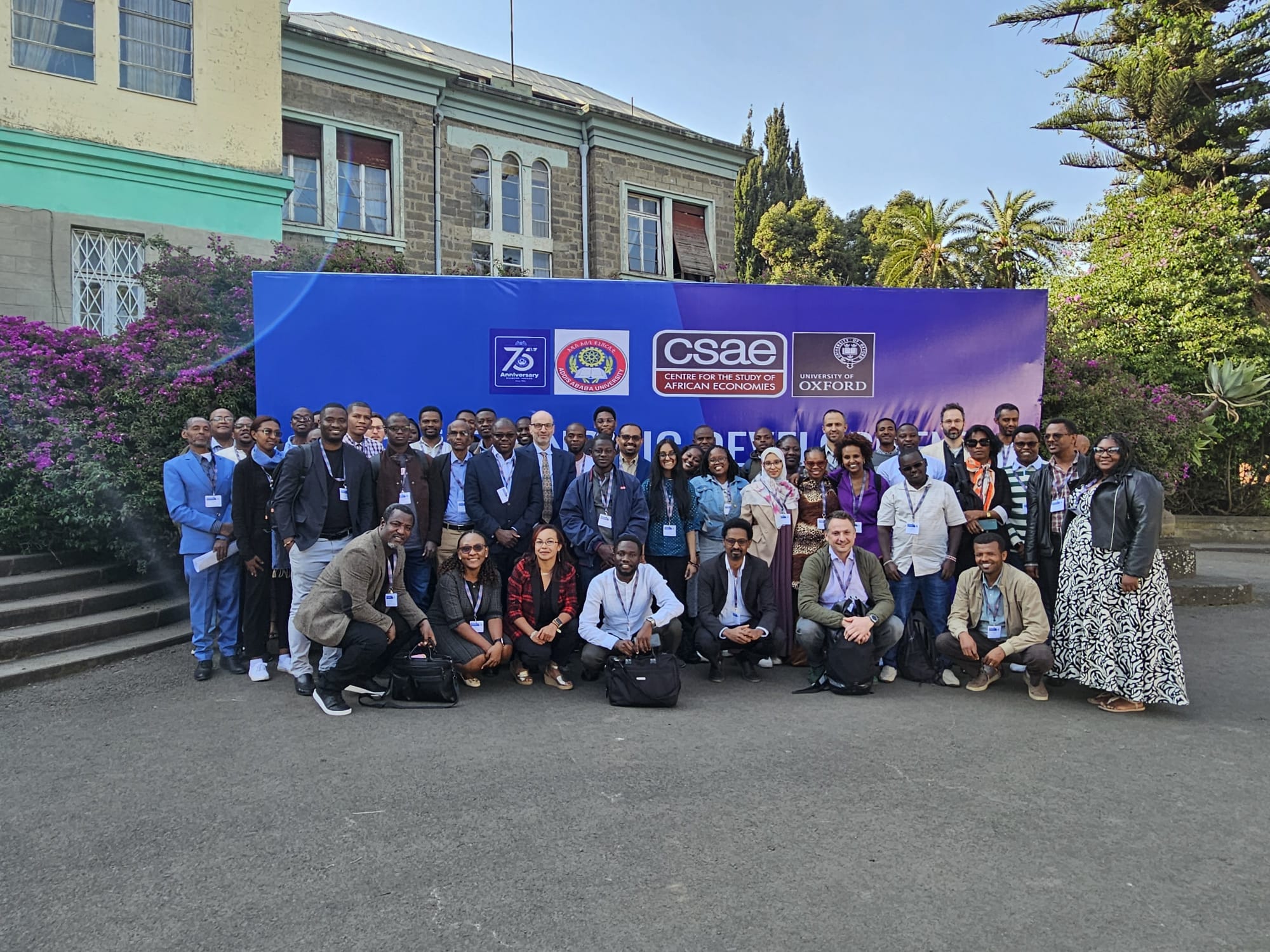
2025 cohort for the CSAE Economic Development in Africa Workshop 2025 at Addis Ababa Univeristy, December 2025.